By Joan Juanola, CEO of Jansa Metal, more than 40 years manufacturing and assembling metal structures.
The difference between planning and commitment
When we talk about construction deadlines, the first thing to define is what kind of planning we are talking about. A planning that is made on a sheet of paper, whether physical or digital, can be adapted at will, depending on the milestones that need to be met. It doesn’t matter in which format it is presented: it will always reflect a more or less optimistic “will” or “forecast”.
It is well known that deadlines are not usually respected in construction. There are always reasons, even excuses that alter them. Without going any further, we all have in mind the delay of the Camp Nou. A world-class project, with seemingly unlimited resources, and the deadlines became a dead letter.
When we talk about real deadlines that must be met without excuses, the subject changes completely. Planning reliability depends on multiple factors. In our experience (more than 1,000 works executed since 1982) they boil down to four critical factors.
But before we get into them, let’s get to what most of you are interested in knowing when you come to this article: how long does a steel structure project really take from start to finish?
Actual times, phase by phase
There is no magic here. There is work, coordination and a factory that runs parallel to the construction site. This is what we find on standard projects of 50 tons and above:
Phase 1 – Engineering and technical design, 2 to 6 weeks
The structural calculationThe structural calculation, the fabrication drawings, the 3D BIM model, the executive project with all the details of joints and purlins… All this has to be closed and validated before the first profile is cut in the workshop. In complex projects such as data centers hospitals o singular structures this phase can extend from 1 to 3 months depending on the volume and complexity of the project. In standard industrial buildings, we are ready in 2-3 weeks.
The most common mistake we see in the sector: starting manufacturing with half-engineering. Result: modifications that force to improvise changes in the workshop, assembly delays, extra costs, loss of quality and often traceability.
Phase 2 – Shop fabrication, 4 to 10 weeks
This is where a well-equipped factory makes the difference. At Jansa we work with state-of-the-art CNC automatic production lines: welding robotswelding robots, plasma cutting plasma cutting lines y laser cutting lines. We do not improvise, we manufacture with precision and guarantee quality and traceability.
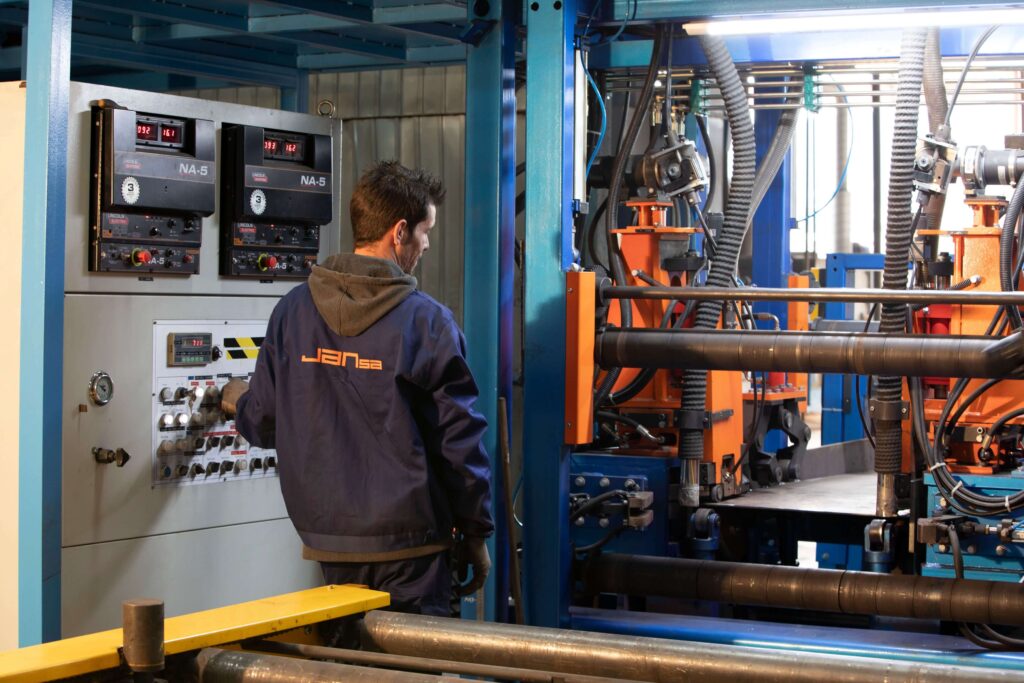
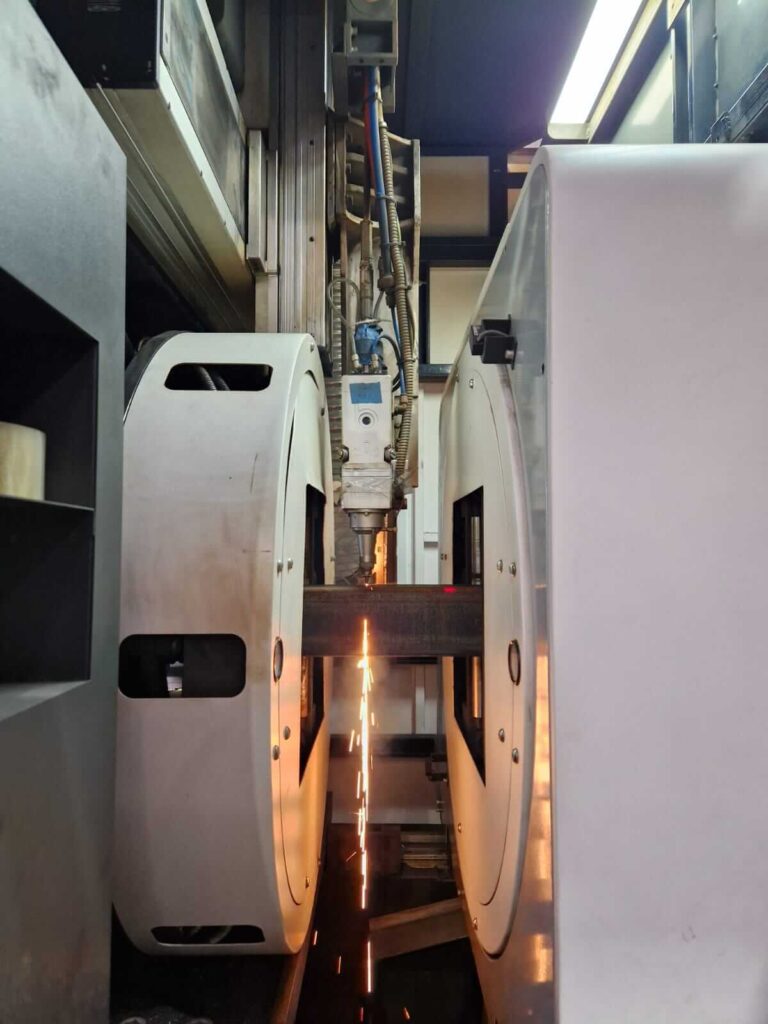
For an industrial building of 2 to 10,000 m², we are talking about 2 to 5 weeks of fabrication. For structures of 500 to 1,000 tons such as shopping malls shopping malls, corporate buildings or data centers the estimated time is between 5 to 10 weeks.
The key that no one says: while the digging is starting, we are already manufacturing. That’s real CONVERGENCE. Steel does not wait for concrete to harden. IF A CONSTRUCTION TEAM IS CREATED, the coordination between the promoter, the civil constructor and us is good, we gain MANY weeks of work without rushing or improvisations, safe work and step by step always forward, no step backwards, sometimes a snail can arrive before a hare, the snail never goes backwards.
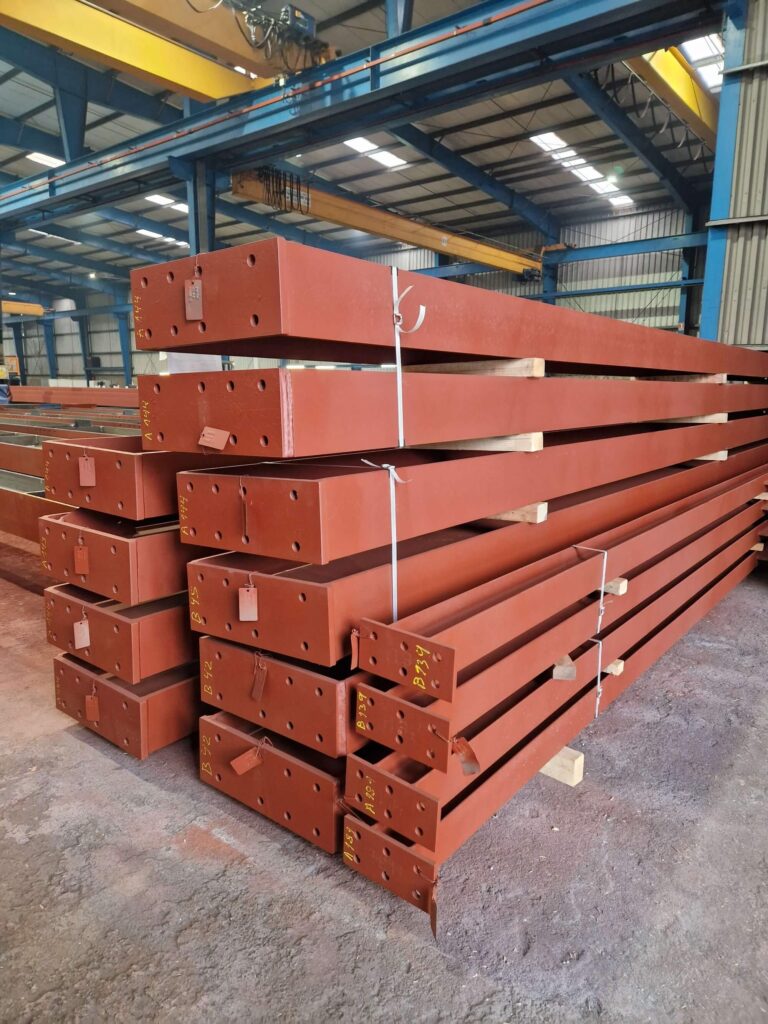
Phase 3 – Transportation and logistics: variable, but plannable
Transportation is not a secondary phase. It is a vital part as it feeds the assembly. The parts leave the FACTORY marked, numbered and ordered according to the sequence of assembly on site, not according to the order of manufacture. This prevents the assembly team from searching for parts or unloading trucks upside down.
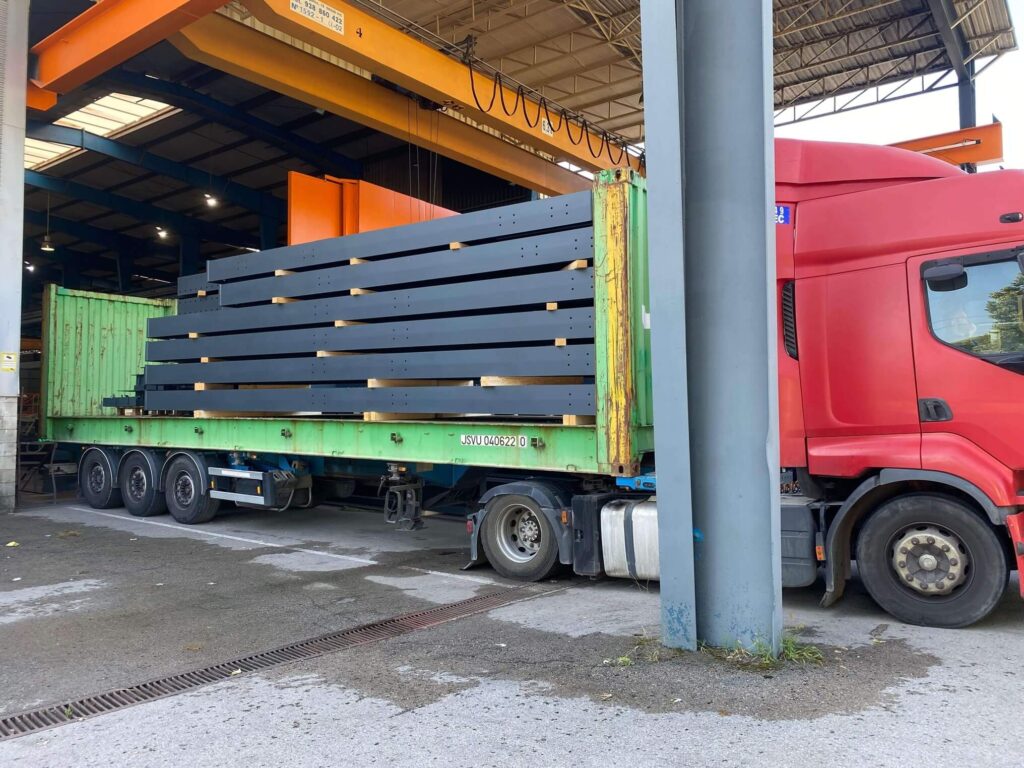
Phase 4 – On-site assembly, from 1 to 8 weeks depending on scale
And here we come to the point that sets steel apart from in-situ concrete: the speed of erection is AMAZING when all of the above has been done right.
A 2,000 m² industrial building with a simple structure can be erected in 1-2 weeks.
A multi-story building structure of 300-500 tons takes 4 to 8 weeks.
A data center with a complex structure, irregular geometry and high technical requirements, such as the data center we built in Badalona, takes around 6-8 weeks to assemble.
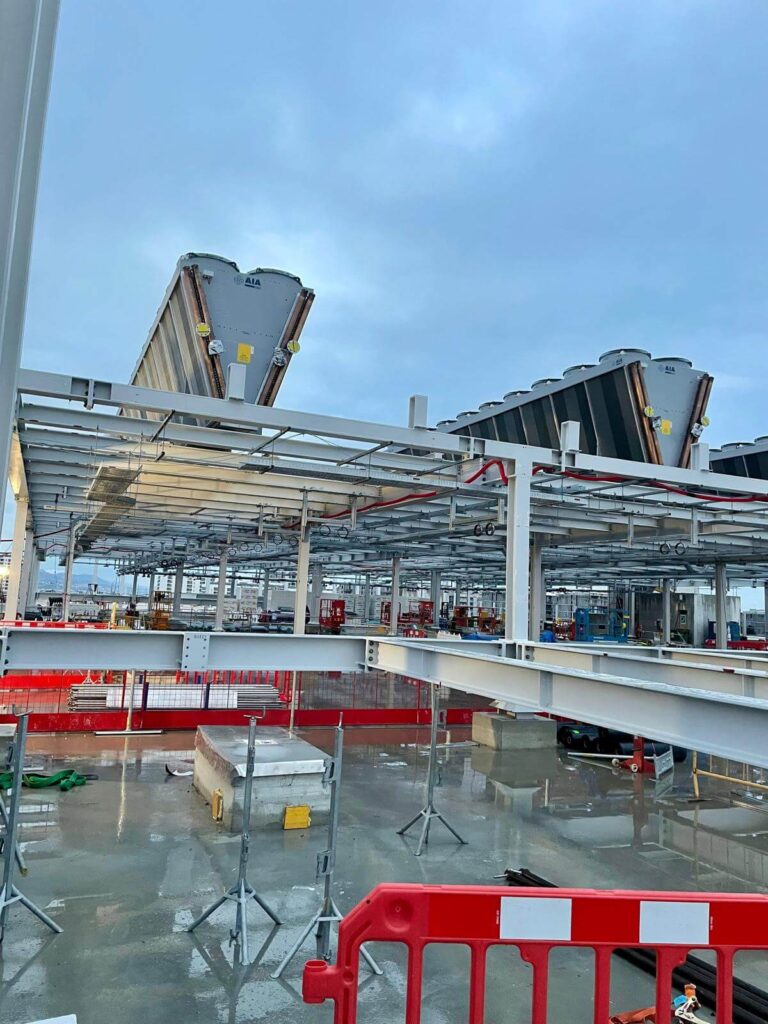
Steel does not require curing time. There is no waiting. What is manufactured today is ready and painted for loading tomorrow.
Summary of indicative time frames for the most common projects
| Type of project | Engineering | Manufacturing | Mounting | Approximate total |
| Simple industrial building (60-100 t) | 2-3 wks | 3-5 wk | 2-3 wks | 7 to 11 weeks |
| Complex industrial building (200-800 t) | 3-5 wk | 5-10 wk | 3-6 wks | 11 to 21 weeks |
| Multistory building (400-1000 t) | 4-7 wk | 7-10 wk | 5-10 wk | 16 to 27 weeks |
| Singular structure (400-1000 t) | 7-10 wk | 10-14 wk | 6-12 wks | 23 to 36 weeks |
These deadlines are indicative and assume closed engineering, anchors in place AND VERIFIED. CONSTRUCTION TEAM with fluid coordination between all the agents. The manufacturing and assembly deadlines overlap in part with the civil works deadlines.
4 critical factors that determine whether or not a deadline is met
1) A reliable construction system from the foundation to the last bolt
A construction system is reliable when it has a proven experience behind it, repeatedly tested and improved in each execution. Reliability is the result of a CONSTRUCTION PROCESS, years of experience and continuous improvement, there are NO CHOICES.
*Warning, something that is often overlooked: a construction system is only as reliable as its weakest link. It is no use if the assembly of the structure is perfectly executed if there are delays in the previous step, the foundation and placement of the anchors. A delay in that phase drags down everything that comes after. And what comes after has resources that do not wait: a special crane reserved for a specific date, an assembly team with a committed schedule, a client with an immovable start date. Technical resources and qualified personnel are increasingly scarce. A delay is not so easy to recover from and can be irreversible.
That is why at Jansa we understand that we must manage and ensure a CONSTRUCTIVE PROCESS that begins with the foundation and ends with the last screw tightened. And that process has to work as a gear.
Weekly follow-up of the planning.
To ensure that the system is running according to plan, measure and verify each week that the execution is on schedule, and act immediately on any deviations. Do not wait for the next site meeting. You have to act immediately. The reaction time on site is what separates a manageable problem from a chain delay.
Plug & Play jointing system, no improvisation on site
This software term perfectly describes what has to be a structural bond. structural connection on site: Plug & Play. You plug it in, it works. No last-minute revisions, no uncertainty.
Today this is only guaranteed by bolted joints. On-site welding has two fundamental problems that make it incompatible with rigorous deadline management.
First, it requires a highly skilled welder, but it also requires “his circumstances”: his condition, the environment, the weather conditions. The best welder in the world can have a bad day. The consequences can even block the progress of the work.
Second, the quality control of a weld stops progress. If a failure is detected, the work is not only stopped: it is reversed.
A bolted joint only requires pulling the trigger of a screwdriver until it stops when the required torque is reached. The screwing time is predictable to within plus/minus one minute. Quality control can be performed at any time without affecting the feed rate. No surprises. No delays due to weather conditions. No dependence on physical condition and circumstances.
Manufactured to an accuracy of ±1 mm
For the bolted joint system to work like a Meccano, the structure must be manufactured with an accuracy of ±1 mm. This is the technical requirement that allows each piece to fit with the next without on-site adjustments, without grinding, without improvisation. In our factory, thanks to automation in cutting and drilling, we ensure the quality and precision of production every day.
The anchoring system, the most critical point of the entire project
If we had to point out the cause that causes the most delays in steel structure projects metallic structureit would be this: poorly executed foundation anchorages. It is the main cause of problems on site, and it is the one that is most underestimated in the planning phase.
For a structure bolted with millimeter precision to be installed like the Meccano it is, the anchors must be positioned with the same precision. This task, which is often taken for granted, cannot be left to chance. The process must be clearly defined, rigorously executed and verified.
At Jansa we manage it like this: before concreting, the anchorages are topographically checked and the Preliminary Stakeout Act is signed. Only then we proceed to the concreting. Once the concrete is poured, the position is checked again and the Definitive Stakeout Record is signed. This document is the one that initiates the assembly of the structure. Without this document, the structure is not erected. Without exception.
2) Adverse weather conditions: the real excuse and the easy excuse.
Let’s be clear, weather does affect assembly. A day of strong wind can stop the crane. A week of heavy rain can condition access to the site. This is real and there is no one who can change it.
What is not acceptable is to use weather as an excuse for delays that in reality come from poor planning. In our experience, most of the “rain delays” we see in the industry are actually delays due to lack of material, last minute project changes or lack of coordination between trades.
The difference is that it doesn’t rain at the FACTORY. Manufacturing does not stop because there is bad weather on site. A good planning contemplates real weather cushions of 2 or 3 days per month in winter in Atlantic climate zones, practically ZERO in summer in Mediterranean zones.
3) One-way teamwork
This is the factor that appears the least in contracts and the most HARMFUL when it does not exist. A well-executed steel structure project requires that engineering, FACTORY and site work go in the same direction from day one.
In practice this means 4 PREMISES.
1) STRUCTURED AND VALIDATED EXECUTIVE PROJECT
A WELL STRUCTURED EXECUTIVE PROJECT, the Germans say “it is half execution”, really if we have a well structured executive project and a reliable construction process, the work will move forward like a freight train.
2) NO PROJECT CHANGES
A change of project when you already have 200 tons manufactured is not an “adjustment”, it is a problem that CANNOT BE CORRECTED WITHOUT AFFECTING THE WORK PERIOD. The changes to be made will be made at the end of each assembly phase without affecting the progress planning.
3) CONSTRUCTION EQUIPMENT
Teamwork on validated plans, each part of the team focused on doing its job correctly and on time, real time information of the inconveniences/impredictions to give immediate response.
4) SUPPLY CHAIN
Transportation is planned according to the sequence of assembly, not according to anyone’s convenience
The parts arrive on site in the order in which they are to be assembled. And the assembly team knows the project before they set foot on the site, with the 3D IFC model that we generate in engineeringEach assembler knows exactly which part goes where, in which position and with which joint, before getting out of the van.
At Jansa we have been working in this way for 40 years because we learned (sometimes the hard way, like everyone else) that speed on site is the result of previous coordination, not of running faster but of working in a structured process without changes and without a step backwards.
4) Complexity of the structural project
The fourth factor is the one that varies the most from one project to another and the one that is most frequently underestimated in the bidding phase. It is not the same to calculate, manufacture and assemble an industrial building with orthogonal geometry and conventional loads as it is to deal with a data center with seismic requirements, mixed slab structures, unique geometries and high fire resistance requirements. It is not the same in terms of time, technical resources or permissible margin of error.
Structural complexity has a direct and proportional impact on each phase of the project. In engineering, a complex structure not only requires more hours of calculation, it requires more validation iterations, more coordination with other specialists (installations, facade, concrete structure…) and more detail in the fabrication drawings.
In the shop floor, complexity translates into unique parts that cannot be mass produced, special joints that require more dimensional control and welding times that do not keep pace with standard production.
In assembly, irregular geometry or special loads may require specific lifting equipment, more demanding assembly sequences and greater technical supervision in the field.
This is not a problem, it is the reality of the industry. The problem arises when the same deadlines are applied to projects of radically different complexity. At Jansa, before committing to any date, we analyze the real complexity of the project (not the one that appears in the executive summary, but the one that is in the plans) because a wrongly estimated deadline from the beginning is an announced delay.
We have executed projects of all kinds; logistics warehouses of 10,000 m² with very tight deadlines, residential steel buildings, infrastructureinfrastructure footbridges, hospitals, shopping malls, waste treatment plantswaste treatment plants, data centers with extreme technical requirements. Each one has its own logic. Knowing this logic in advance is what allows us to give deadlines that are then met.
Final summary and conclusions on actual lead times for structural steelwork projects
A construction deadline in steel structure is not a promise, it is the result of doing well each of the previous phases. If the engineering is closed, if the workshop runs parallel to the foundations, if the anchorages are topographically verified before concreting, if the transport arrives in orderly sequence, if the joints are bolted and do not depend on anyone’s mood, and if the site team knows exactly what it has to do before arriving: the deadlines are met. Not by chance. By system.
At Jansa we have been proving it for more than 40 years. More than 1,000 projects executed, from logistics warehouses to data centers, from hospitals to photovoltaic canopies with a common denominator: we reach the agreed date.
If you have a project in hand and you want to know what real timeframe is feasible for your specific case, contact our team. No commitment and no frills.
Jansa Metal, Manufacturers of metallic structures since 1982. Engineering, fabrication and assembly. EN1090 EX3 Certification.