There are suppliers who display a certificate as if it were a trophy. And there are suppliers who understand what’s behind it. The difference can cost you a job, a penalty or worse.
Imagine that you hire a steel structure supplier. He sends you the EN 1090 certificate. You sign the contract. And three months later, during an inspection, you discover that this certificate does not cover the kind of execution your project needs.
It is not an invented scenario. It happens. And when it happens, it’s your problem.
That’s why this article is not going to be a copy of the Official Gazette. It’s going to be what you need to know before you choose someone to fabricate your structures.
What is EN 1090 and why does it matter more than you think?
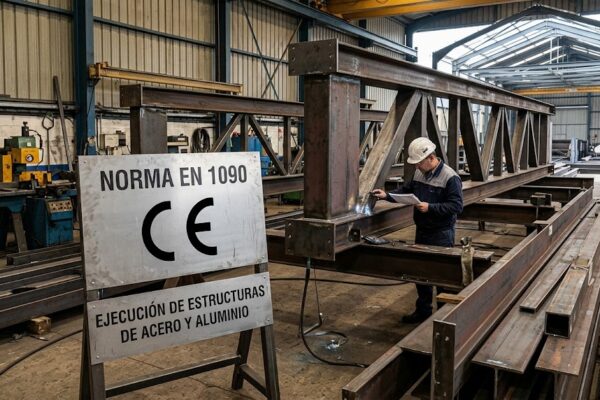
The European standard EN 1090 regulates the manufacture of steel and aluminum structural components. It has been mandatory in Spain since 2014. Without it, a metal structure cannot be CE marked. Without CE marking, it cannot be legally placed on the market.
So far, the basics.
What many people don’t know is that EN 1090 is not a single thing. It is divided into parts, and within those parts, into different levels of requirements depending on the type of structure or type of work.
| THE PARTS OF THE EN 1090 STANDARD EN 1090-1 – Requirements for the assessment of conformity of structural components. CE marking.EN 1090-2 – Technical requirements for steel structures. The one that most affects manufacturing.EN 1090-3 – Technical requirements for aluminum structures. |
The hard core is in part 2. And within it, in something called Execution Class.
Execution classes: the detail that changes everything
The standard defines four performance classes (EXC1, EXC2, EXC3, EXC4). Each one implies a different level of control, documentation and technical requirements. A supplier can be certified for EXC2 and not be qualified for EXC3. If your project requires EXC3 and the supplier only has EXC2, his certificate is useless. Point.
| Class | Typical use | Requirement |
| EXC1 | Agricultural buildings, residential railings, structures with little human presence | Minimal |
| EXC2 | Buildings from 2 to 15 floors, conventional industrial buildings. The most common in the market | Standard |
| EXC3 | Structures with dynamic loads, fatigue, high seismicity, buildings with more than 15 floors, walkways, large span roofs. The real roof of the industry. Jansa Metal Certification | High |
| EXC4 | Exceptional cases: deposits in nuclear power plants, large railroad bridges. Additional requirements defined on a project-by-project basis | Maximum – exceptional cases |
An important clarification before continuing: EXC4 exists, but in industry practice it is marginal. It applies to critical infrastructures of an almost exceptional nature, safety tanks in nuclear power plants, large railroad bridges, where additional requirements are defined on a project-by-project basis. For demanding industrial structures, EXC3 is the level that covers everything you need. It is the actual ceiling of the standard market.
“An EN 1090 certificate that doesn’t cover your performance class is wet paper with an official seal.”
How do you determine the type of execution of your project?
It depends on three intersecting factors: the consequence of failure (what happens if the structure fails), the service category (whether there are seismic loads, fatigue, etc.) and the production category (whether there are welds in critical elements or not).
In conventional building construction, EXC2 is the norm. But in industrial roofs with large spans, walkways, structures with fatigue or in seismic zones, EXC3 is necessary. The type of execution must be defined in the project or technical documentation. If it does not appear, it is essential to clarify it before fabrication.
What EN 1090-2 actually requires
Beyond the level of execution, the standard establishes requirements for the entire production process. It is not just about having licensed welders. It’s about having a complete system in place.
Traceability of materials
The traceability system must be able to identify the origin of the material in accordance with the requirements of the project and the standard.
Qualified and certified personnel
Welders must be certified according to EN ISO 9606. Welding coordinators must be certified according to EN ISO 14731. It is not enough that they know how to weld. There must be documentation to prove it and a system to ensure that these certifications are current.
Quality control plan and PCI
The manufacturer must have an Inspection and Test Plan (ITP) or equivalent system within the Factory Production Control (FPC). What is inspected, by what method, how often and by whom.
Welding control
Depending on the type of execution and project specifications, welds must be inspected by non-destructive testing (NDT).
When required by the project or the type of execution, test reports should be included in the final documentation. In EXC3, the acceptance criteria are usually placed at demanding levels (usually level B or C according to EN ISO 5817), although they must always conform to what is defined in the project.
| Red flag: If a supplier cannot provide you with the welding test report along with the structure documentation, something is wrong. |
Statement of Benefits (DoP)
The CE marking is not just a logo. It is accompanied by a Declaration of Performance that specifies the characteristics of the component. Without this document, the CE marking has no legal value.
How to check that a supplier really delivers
This is the part that nobody explains to you. Because asking for the certificate is easy. The difficult part is to know if that certificate corresponds to what you are going to manufacture.
1. Ask for the certificate and read it.
The certificate of conformity of the factory production control (FPC) system must be issued by a notified body. Check that the body is registered in NANDO (the official database of the European Commission). And check that the certified performance class matches the one you need.
| You can check notified bodies at: ec.europa.eu/growth/tools-databases/nando |
2. Ask for the exact scope of certification
Certification may be limited to certain types of joints, thicknesses or materials. An honest supplier tells you. One that doesn’t tell you may not know, or may prefer that you don’t know. If the supplier has EXC3 with no scope restrictions, that’s a sign that the quality system is mature.
3. Ask for the welding coordinator
Who is the coordinator? EN 1090 requires a coordinator with specific technical expertise (according to EN ISO 14731). For EXC3, this competence must be validated and contrasted by the Notified Body. At Jansa Metal, our technical structure not only fulfills the role, but also ensures that the supervision of welding processes is real, constant and professional. If the coordinator does not have the technical capacity demonstrated for the level of your work, the certificate is just a piece of paper.
4. Visit the facilities
There is no substitute for seeing how they work. An EXC3 certified workshop has a recognizable order: identified materials, differentiated areas, visible procedures, accessible records. If you walk into a shop and don’t see any of that, the certificate doesn’t reflect reality.
5. Ask for examples of documentation provided
Any serious manufacturer can show you, with due confidentiality, examples of the documentation he provides to his customers: technical dossier, inspection reports, material certificates, Declaration of Performance. If he has nothing to show you, he has a problem.
QUICK CHECKLIST
The most common mistake buyers make
Treating EN 1090 as an administrative requirement to be ticked off a checklist, rather than what it is: the guarantee that what you are getting manufactured will stand up to what it has to stand up to.
A steel structure does not fail the day it is delivered. It fails years later, in the conditions for which it was not prepared because no one checked whether the supplier was really prepared to manufacture it.
“The cheapest structure is not the one with the lowest price. It’s the one that doesn’t fail.”
At Jansa Metal we manufacture metal structures with EN 1090 certification up to EXC3. We do not say this to show off our paper. We say it because when a client brings us a project with dynamic loads, seismic zone or a large span roof, we want to be able to tell them that yes, we manufacture it, and that we do it with the level of control that the project deserves.
| What EXC3 means in practice: full material traceability, full-time IWE welding coordination, non-destructive testing with level B acceptance criteria, and all documentation ready for any inspection. If your project doesn’t need EXC3, even better: we manufacture it just as well with EXC2, and explain it to you so you know exactly what you’re buying. |
If you have a project in hand and want to understand exactly what kind of execution you need and whether what a supplier offers really covers it, we can help you analyze it. No commitment and no unnecessary jargon.