The question comes up in almost every first project meeting: is concrete or steel cheaper? The honest answer, given by someone who has been at it for four decades, is: it depends on what you are calculating. If you’re just looking at the price per m² of structure, concrete may look cheaper on paper. But if you calculate what the project really costs you, how long it takes to go into production, what you pay for maintenance over 20 years, and what the building is worth when you decide to expand or sell it, the analysis changes completely.
This is called TCO, Total Cost of Ownership . And that’s exactly what we’re going to talk about here, with real numbers and without compromising technical rigor.
Why the initial price comparison is misleading
When someone asks for a quotation for an industrial building, the first thing they receive are construction figures per square meter. And those figures, without context, lead to wrong decisions.
A industrial building with a metal structure today, in 2026, ranges between 180 and 300 €/m² for the cost of the structure and basic enclosure. The same building in prefabricated concrete will cost between €260 and €450/m². The difference is already significant. But that is only the cost of the box. It does not include:
- The cost of time until you can operate
- The foundation, which varies significantly depending on the weight of the structure
- The space required and the associated logistics
- Personnel on site and the actual duration of the process
- 10-, 20- and 30-year maintenance
- The flexibility, or lack thereof, to extend or modify
- Residual value of the building at the end of its useful life
If you want to make an informed decision, you have to look at all these factors at once. That’s the TCO.
The advantage that no one puts in Excel: time, accuracy and efficiency of work

Shop fabrication, assembly in days
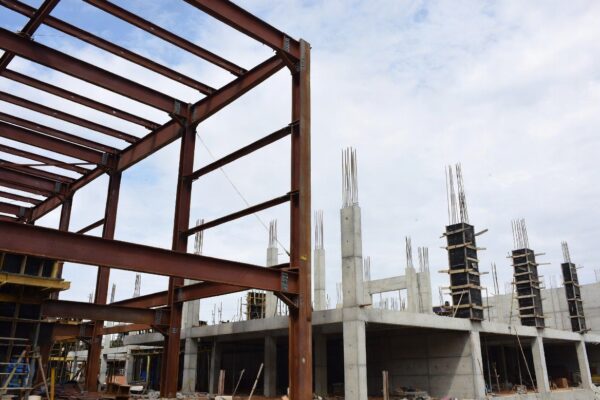
A 2,000 m² industrial building with a steel structure can be erected in 1 to 2 weeks once the foundation is ready. A multi-storey structure of 300-500 tons, between 4 and 8 weeks. The reason is simple: the fabrication is done in the workshop, in parallel to the site preparation, and what arrives on site is marked, numbered and ready for assembly. It is like assembling a large-scale piece of furniture: each piece has its exact place, everything fits together, and the process moves forward without waiting or improvisation.
With concrete, it is necessary to assemble formwork, wait for the concrete to set, coordinate on-site pouring and manage considerably more complex site logistics. Lead times are lengthened and, with them, costs are increased.
Millimeter precision that eliminates chain delays
Steel profiles are manufactured to tolerances of ±1-2 mm in the workshop in an industrialized and traceable process. This has a direct and very valuable consequence: carpentry, facades and installations can be planned and brought forward without any risk of mismatching.
With concrete, tolerances are greater and on-site stakeouts are frequent. What fits on the drawing does not always fit in reality. This generates chain delays and additional costs. With steel structures, this simply does not happen.
Less site space, less personnel, less friction
In-situ or precast concrete erection requires space: stockpiling areas, formwork platforms, auxiliary cranes, heavy truck traffic. On consolidated industrial estates or tight plots, this space simply does not exist. The metal structure needs just enough: an orderly unloading area and working space for the assembly team.
In addition, the process requires fewer operators and a specialized team that works in a coordinated and efficient manner. Delays are virtually impossible unless there is an error in the project phase – and that is where they are prevented.
What does this mean in real money?
If a company takes 2-3 months less time to start production, this time has a direct economic value: no lost sales, provisional facility rentals avoided, personnel that can be hired earlier. In logistics or industrial projects of a certain size, these savings easily exceed €100,000. Sometimes much more. This money does not appear in any construction budget. But it exists.
Foundations, the invisible cost that makes the difference
The specific strength of steel is much higher than that of concrete: with the same weight of material, a steel profile supports much higher loads. Therefore, a complete steel structure can weigh 3 to 5 times less than its concrete equivalent, significantly reducing the loads to be supported by the foundation.
In soft soils – very frequent in industrial areas of the Mediterranean coast or in landfill sites – the foundation for a concrete structure can represent between 15% and 25% of the total cost. With steel, that percentage is significantly reduced. And by moving less earth and working with lighter loads, the time required for this phase is also shortened.
Great lights without pillars, steel has no rival
In industrial, logistics and warehousing halls, clear span is a critical factor. With steel structures, spans of 30, 40 and even 60 meters are perfectly achievable with special trusses or portal frames. Above 20-25 m spans, concrete is no longer technically and economically competitive: the prestressed girders required are heavy, difficult to transport, expensive to erect and generate enormous foundation loads. The steel structure is the only viable option.
Added to this is a growing market factor: the shortage of skilled professionals to execute large-scale concrete structures is increasing throughout Europe. Specialized metal erection teams, on the other hand, work with industrialized processes that are less dependent on the availability of artisan labor.
Fire resistance, from a perceived disadvantage to an integral service
Fire protection is often portrayed as a disadvantage of steel structures. But the reality is more nuanced – and more favorable to steel than is often explained.
First, concrete also loses its ability to resist high temperatures: it is not immune to fire, it simply responds differently. Secondly, passive fire protection for metal structures is now a standard, inexpensive and fast process: intumescent paint, mortar spraying or combined systems that meet regulatory requirements without cost overruns or significant additional lead times.
At Jansa Metal we also offer integral firewall sectorization: not only do we protect the structure, but we also design and execute the compartmentalization solutions that each project requires according to regulations. The fire protection is not a problemis part of our complete service.
Sustainability and green steel, the future is already today
In 2026, the carbon footprint is no longer just a marketing argument: it is starting to become a technical, financial and commercial criterion in many projects. European taxonomy, ESG reporting, BREEAM and LEED certifications, and the future obligation to calculate life-cycle carbon in new buildings are pushing the sector to justify construction decisions with environmental data. In this scenario, steel is clearly winning the game.
- Structural steel has an average recycled content of 70-90% and is 100% recyclable indefinitely without loss of properties.
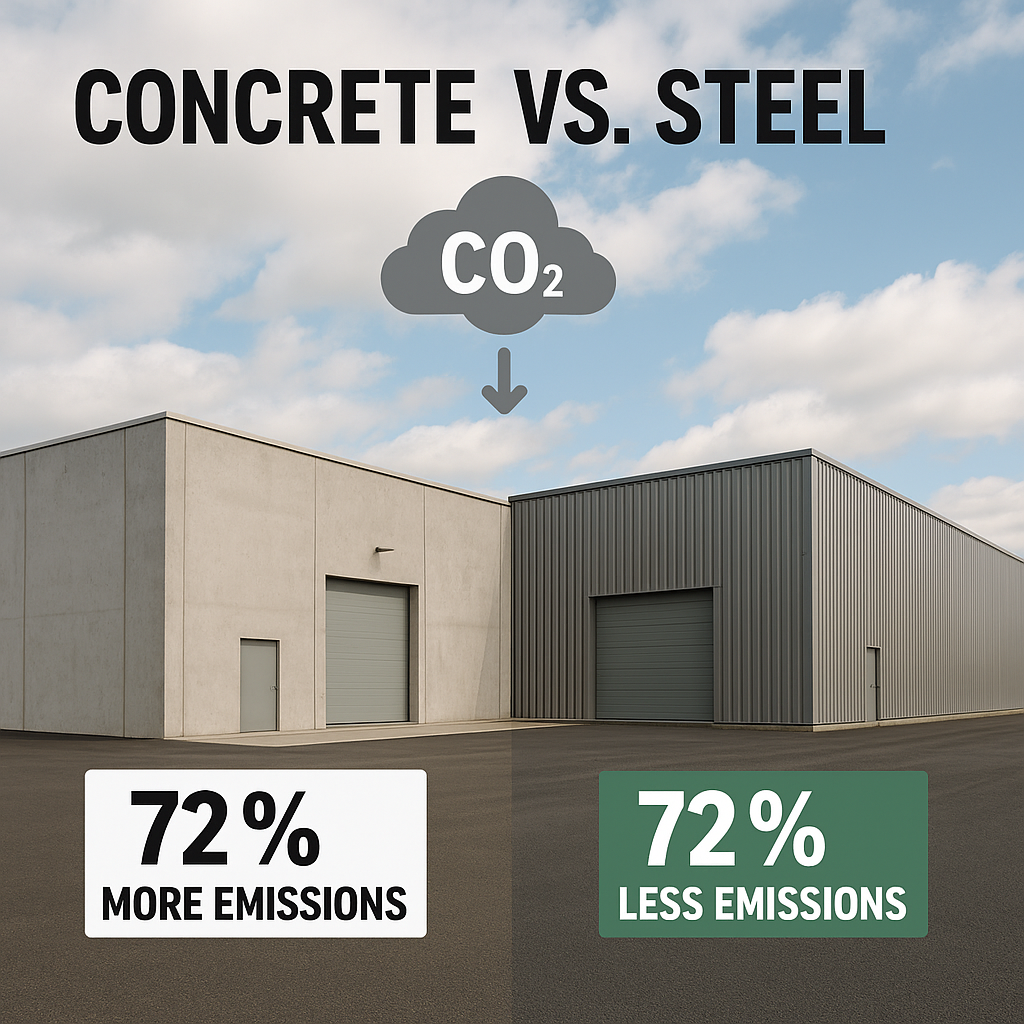
- Green steel, produced in electric arc furnaces with renewable energy, is already commercially available and reduces CO2 emissions from the steelmaking process by more than 70%.
- A metal structure can be dismantled, reused or extended without demolishing the building. Circular economy applied to construction.
- Transporting a 2,000 m² metal building to site requires 4-8 trucks. The same precast concrete building may require 40-60 heavy truck movements, with all that this implies in terms of emissions, special transport permits and logistical coordination.
Concrete generates approximately 900 kg of CO2 per ton of cement produced. And when the building reaches the end of its useful life, it generates a volume of rubble with practically zero recovery value. Steel has real residual value: it is even traded on the market as scrap.
The honest factor-by-factor comparison
There is no universal winner. The right answer depends on the project. What we can do is show you the complete analysis, without conceding advantages that do not exist:
| Factor | Metal structure | Precast concrete |
| Structure cost (€/m²) | 180-300 €/m² – savings of up to 40%. | 260-450 €/m² |
| Foundations | 3-5× lighter: lower cost and shorter lead time | More robust and costly due to higher own weight |
| Assembly time | Weeks – shop fabrication in parallel to the construction site | Longer: formwork, setting, on-site coordination |
| On-site space | Minimal: orderly unloading and direct assembly | Extensive: formwork, auxiliary cranes, stockpiling areas |
| On-site personnel | Reduced equipment, industrialized process, no improvisation | More operators for longer periods of time; increased risk of delays |
| Dimensional accuracy | ±1-2 mm shop floor: carpentry and installations are advanced without risk | Major tolerances: frequent re-setting and chain delays |
| Fire resistance | Standard passive protection + integral firewall sectoring | Natural, but concrete also loses strength at high temperature. |
| Maintenance (25 years) | Low with correct initial protection (galvanized, epoxyduplex system) | Low in standard environment, but with real pathologies in the long term |
| Large lights without pillars | Up to 60 m and over – unrivaled above 25 m | Economically unfeasible above 20-25 m |
| Flexibility and extensions | High: new bolted gantries, non-stop production | Very low: partial demolitions, staking out, major construction work |
| Sustainability | 70-90% recycled – 100% recyclable – green steel available | High CO2 footprint in cement – rubble with no residual value |
| Transport to construction site | 4-8 trucks for 2,000 sq. m. warehouse | 40-60 heavy truck movements with special permits |
| Residual value | High: dismountable, reusable, scrap market value | Practically nil |
| Singular geometries | Very high versatility: overhangs, curved roofs, complex façades | Limited: standard geometries with conventional formwork |
A real example to make the numbers concrete
Industrial building of 2,000 m² in the metropolitan area of Barcelona, free height of 8 meters, without bridge crane and with standard enclosure.
| Option A – Steel structure |
| Structure + enclosure: ~420.000 € (210 €/m²) Lightened foundation: ~60.000 € Corrosion protection (shot blasting + epoxy): ~18.000 € Fire protection and sectorization: included in integral projectTime until operational: 14-18 weeks |
| Estimated total: ~498,000 €. |
| Option B – Precast concrete |
| Structure + enclosure: ~580,000 € (290 €/m²) Reinforced foundation: ~95,000 € Formwork management and coordination: additional cost not always budgetedTime until operational: 22-28 weeks |
| Estimated total: ~675,000 €. |
Direct difference in initial investment: ~177,000 € in favor of steel. If we also quantify 2-3 months less time to go into production – with a conservative impact of €60,000 in revenue not lost or costs avoided – the real differential exceeds €230,000. And that’s not counting the differential value if in 5 years the company needs to expand the hall: in steel, adding 1,500 m² is a weeks-long operation. In concrete, it is a major project.
This is an indicative estimate, not a budget. Each project has its own constraints. But it serves to illustrate what magnitudes we are talking about when doing the complete analysis.
When to choose a steel structure
After more than 40 years and more than 1,000 projects executed, our recommendation is as follows. Choose a metal structure when:
- The start-up time is a critical variable for the business.
- The project may need to be expanded or modified in the future.
- The vessel requires large pillar-free spans (from 20 m, steel is unrivaled).
- The site is tight or has difficult access for concrete machinery.
- Soil is soft or deep foundation would significantly increase cost
- Sustainability is a project or environmental certification requirement
- The geometry is irregular or the architectural design has unique requirements
- You are looking for an asset with real residual value and the possibility of dismantling or relocation.
And in many projects, the best solution is a mixed structure: concrete columns or slabs where they add value, and steel where speed, free span or flexibility matter. There are no dogmas. There is engineering.
How we help you calculate the TCO of your project
At Jansa Metal we do something that very few shops offer: prior analysis without commitment. Before there is a formal quotation on the table, our engineering team engineering team can make a comparative estimate of the total cost of your steel project, with the real data of your plot, your activity and your time horizon, so that you can make your decision with numbers, not with intuitions.
It’s not a sales gimmick. It’s the only way to do our job well.