
Engineering and design
Connection design.
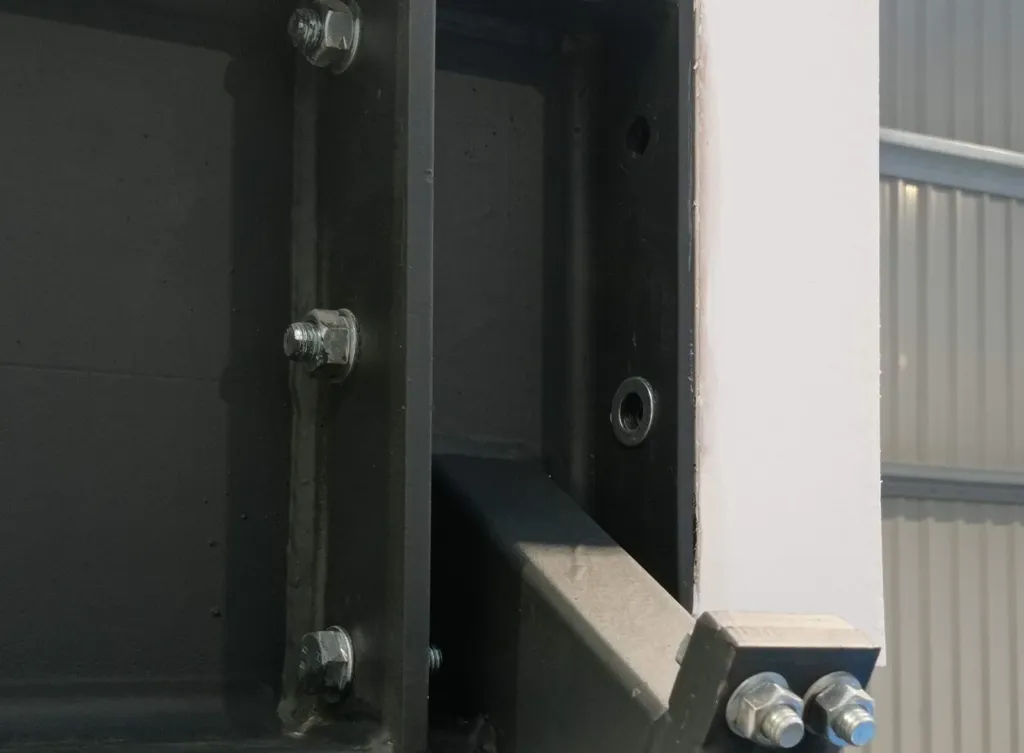
Connections designed for fast erection and for extending the structure in the future.
Bolted and welded connections
Easy to erect, easy to extend.
We size the connections between column, beam and purlin according to the project’s actual forces.
We mainly design pinned bolted connections, and calculate welded connections when the project requires them.
Benefits
What you gain with our connections.
Faster erection
Simple installation on site.
Safety and precision
To CTE DB-SE-A and Eurocode 3.
Dismantling or extension
You modify the structure without rebuilding it.
Technical advice
We support you at every decision.
How we do it
Four steps.
1. Analysis
We study the loads, materials and structural type to determine the forces.
2. Connection type
Fixed, semi-rigid or pinned, and bolted or welded.
3. Regulations
Calculation to CTE DB-SE-A and Eurocode 3 (EN 1993-1-8).
4. Documentation
Detail drawings, specifications and full calculations.
Plug & Play
Connect it and it works.
The bolted connection is what makes deadlines achievable: it is tightened to the required torque and its timing is predictable.
It depends less on the weather, and its quality control can be done at any time without slowing the site. To make it fit together like a construction kit, we fabricate to an accuracy of ±1 mm.

In detail
Three types of connection, three behaviours.
Pinned, bolted
The type we design most: easy to erect, and it can be dismantled or extended without affecting the structure.
Semi-rigid
It transfers part of the bending moment and allows some rotation. It is designed from its moment-rotation behaviour, to EN 1993-1-8.
Welded
We check each weld for shear, axial force and moment, and specify it for the welder and the inspector.
FAQ
What we are asked most.
What does connection design include?
Sizing of the connections, with detail drawings, bolt specifications and full calculations.
What are the advantages of bolted connections?
Fast erection, easy dismantling, verifiable tightening and less dependence on the weather.
What are semi-rigid connections?
They have a stiffness between fixed and pinned, and allow controlled rotation.
Do you design welded connections?
Yes: weld type, throat, effective length and geometry to EN 1993-1-8.
What is considered when designing a connection?
Static, dynamic and seismic loads, the steel grade and sections, the behaviour required (pinned, semi-rigid or fixed), access for inspection and maintenance, and the standards.
When are semi-rigid connections used?
In buildings that need to absorb deformation or movement, such as differential settlement, earthquakes or temperature changes, without the stiffness of a fixed connection.
Get your structure ready for the future.
Request your connection design.