
Engineering and design
Fire resistance.
We calculate the exact intumescent paint thickness member by member: you comply with the standard and pay only for the protection you need.
EN 1993-1-2 and DB-SI
From calculation to protected member.
We agree the fire resistance period with you, recalculate the structure in the fire scenario and set the intumescent paint thickness for each section.
In line with Eurocode EN 1993-1-2 and the SI Basic Document of the Spanish Building Code (CTE).

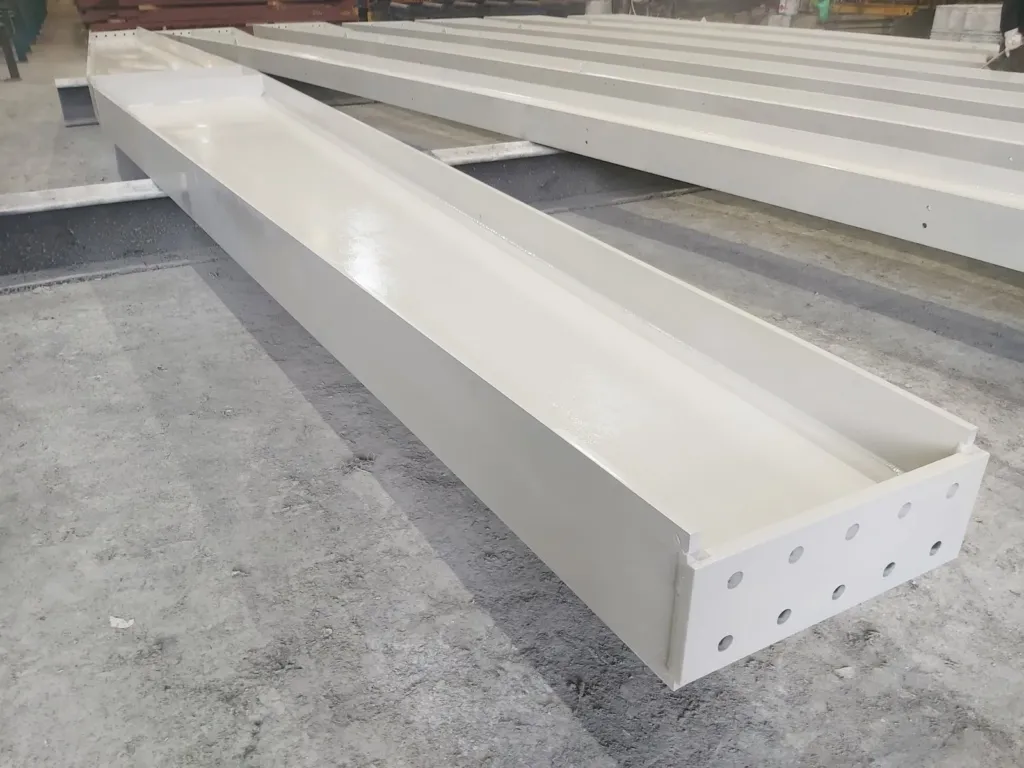
Member by member
Each member, its exact thickness.
An R60 can mean many different thicknesses. Two beams in the same building may need very different protection.
What changes is the load each member carries in a fire and its section factor: a slender section heats up faster than a heavy one. That is why we calculate each element separately: no over-protection, which adds cost, and no under-protection, which leaves the structure non-compliant.
Benefits for your project
Protection ready to erect.
Regulations
Technical report to EN 1993-1-2 and DB-SI.
Speed
Report in 3 to 5 working days.
Ready to erect
It leaves the plant with the paint applied and cured.
RAL finish
Topcoat in the project colour.
How we do it
Five steps.
1. Planning
Required level according to use and fire compartment.
2. Recalculation
Critical temperature of each section.
3. Thickness
According to the required period and the section factor.
4. Application
Shot blasting to SA 2½, primer and intumescent paint.
5. Delivery
Elements ready to erect.
What the standard requires
How many minutes your building must withstand.
Under the Spanish CTE DB-SI. In commercial and hospital buildings, the basement rises to R 180 if the evacuation height exceeds 28 m. In Spain, industrial buildings are governed by Royal Decree 164/2025 (RSCIEI): the requirement depends on configuration, risk and compartment. For projects in other countries, local regulations apply.
Where the savings are
Four decisions that make protection cheaper.
Define the R at the start
If it comes up once the structure is already fabricated, protection ends up being done on site, taking longer and with less control.
Calculate each member
Using the thickness of the worst-case section across the whole project multiplies the product used without adding safety.
Ask for R for beams and columns
R is load-bearing capacity and EI is compartmentation. Mixing them up produces quotes that cannot be compared.
Include the connections
They are also part of the structure and are checked in the fire scenario.
FAQ
What we are asked most.
What information do you need?
Basic drawings, the required resistance level and the critical temperature if already defined. If you do not know the classification, we will determine it.
How long does it take?
The calculation takes 3 to 5 working days, and painting and curing in the workshop 1 to 2 days depending on thickness.
How does intumescent paint protect?
With heat it expands up to 50 times and forms a thermal barrier that delays heat reaching the steel.
Does it need maintenance?
Not in dry interiors. Outdoors or in humid environments it has a sealing topcoat.
Do all beams and columns need the same paint thickness?
It depends on the load and section factor of each section. That is why we calculate member by member: it avoids applying too much or too little.
What does R60 mean?
That the element keeps its load-bearing capacity for 60 minutes in the ISO 834 standard fire.
At what temperature does steel fail?
It melts above 1,400 °C, but it loses strength as it heats up. Its critical temperature is usually around 550 °C and is calculated for each member.
Does every steel structure need protection?
It depends on the required R and the calculation. Some elements have no requirement, and some low-requirement cases are solved with heavier sections, always justified by calculation.
Which regulations apply to an industrial building?
In Spain, the Fire Safety Regulation for Industrial Establishments (RD 164/2025). A detached single-storey industrial building may need far less protection than offices of the same floor area. In other countries, local regulations apply.
Can it be combined with corrosion protection?
Yes. At our plant we combine intumescent protection with the JANSCOAT or DUPLEX systems, depending on the environment.
Protect your project.
Send us the drawings, the building use and the required resistance level.