What Happened in Venezuela and Why It Affects Us
On June 24, 2026, Venezuela experienced an exceptional double earthquake: a first earthquake measuring 7.2 on the Richter scale, followed just seconds later by a second earthquake measuring 7.5, both with their epicenters in the state of Yaracuy. Satellite imagery and initial damage assessments indicate that tens of thousands of buildings were affected.
However, from an engineering standpoint, magnitude alone does not explain the extent of the damage.
Initial technical assessments point to factors that have been known for decades in seismic engineering:
Debunking the Myth: Spain Is, in Fact, an Earthquake-Prone Area
There is a perception that major earthquakes are a problem exclusive to Japan, California, or Latin America.
The reality is different.
Spain has a specific standard for earthquake-resistant construction, NCSE-02, which was approved by Royal Decree 997/2002.
Its application depends on various factors:
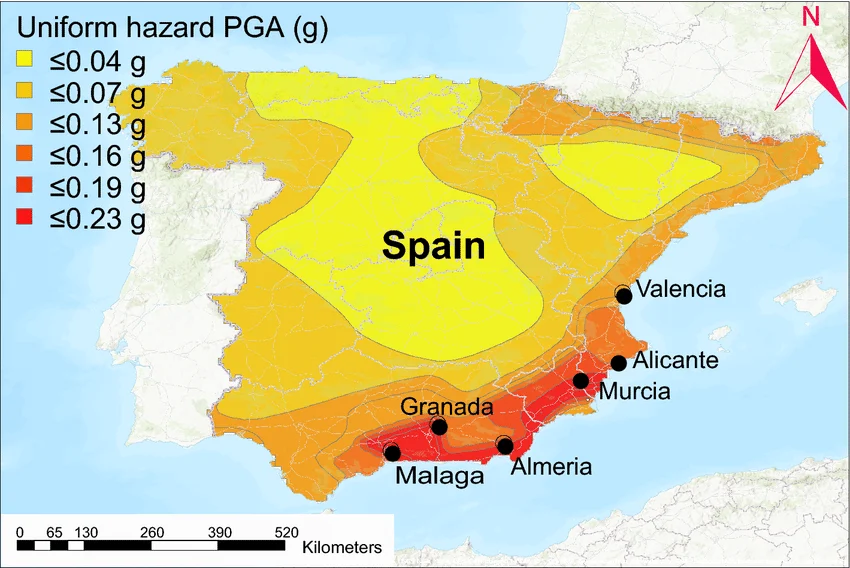
The areas with the highest seismic risk are mainly concentrated in:
However, there are also areas subject to seismic requirements in regions such as Catalonia, the Valencian Community, Navarre, and the Pyrenees.
In other words: earthquake-resistant design is not an issue exclusive to southern Spain.
Furthermore, the 2011 Lorca earthquake highlighted the need to continue updating the regulations and gradually align them with the most advanced criteria of Eurocode 8.
What Japan Teaches Us About Earthquake-Resistant Construction
When it comes to seismic engineering, Japan remains the global benchmark.
And it is interesting to note that the evolution of Japanese engineering has not consisted solely of building stronger structures.
The current goal is much more ambitious: to prevent the energy from the earthquake from reaching the structure.
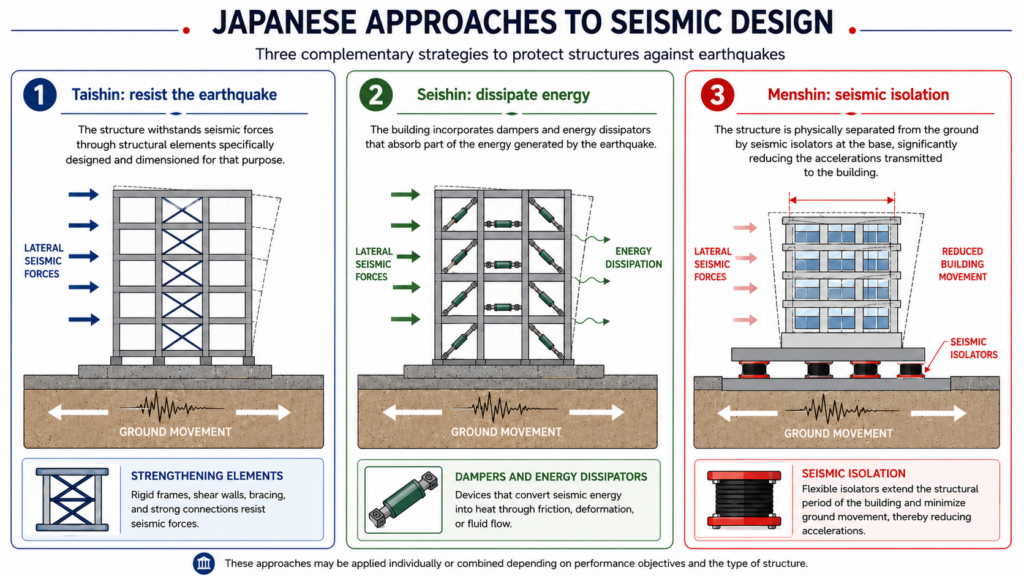
The three main strategies currently in use are:
Taishin: Withstanding the Earthquake
The structure withstands seismic forces through structural members specifically designed for that purpose.
Seishin: to dispel energy
The building incorporates dampers and energy dissipators that absorb some of the energy generated by the earthquake.
Menshin: Seismic Isolation
The structure is physically decoupled from the ground by special isolators installed at the base, drastically reducing the accelerations transmitted to the building.
The lesson is clear:
The countries most advanced in seismic engineering have moved beyond the traditional concept of “withstanding an earthquake” toward systems capable of dissipating energy or isolating the building from ground motion. In this context, the high ductility and light weight of steel structures make them one of the most effective solutions for modern seismic-resistant design.
Why Steel Offers Seismic Advantages
The main advantage of steel over other structural systems has a technical name:
Ductility
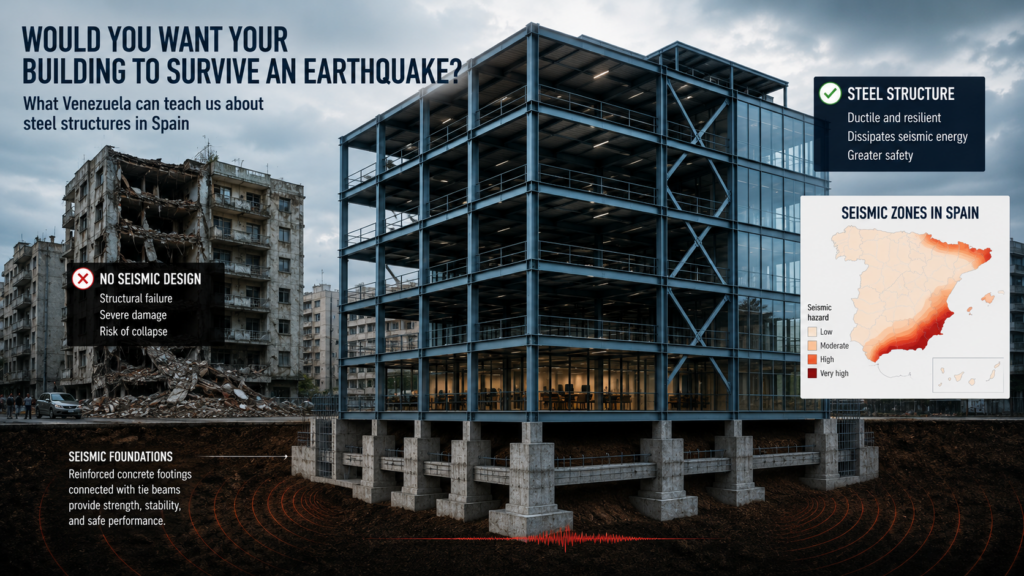
A ductile structure is capable of undergoing significant deformation before collapsing, thereby absorbing and dissipating energy during an earthquake.
Put simply:
Steel is not meant to be completely rigid. It is meant to deform in a controlled manner.
It is precisely this ability to deform that allows many buildings to remain standing even during extremely severe seismic events.
Modern seismic engineering favors highly ductile structural systems, in which steel offers significant advantages over conventional reinforced concrete.
Advantages of Steel Structures in Seismic Zones
* High ductility
It allows for large deformations before failure.
* Lower weight
Less mass means less seismic force on the structure and foundation.
* Quality Control
In-house manufacturing provides greater control over dimensions and workmanship.
* Ease of reinforcement
Subsequent modifications are easier than with many concrete structures.
* Compatibility with advanced systems
Metal systems are particularly well-suited for heat dissipation and seismic isolation solutions.
Weight is a particularly important factor.
The seismic force acting on a structure depends directly on its mass.
A steel structure is typically significantly lighter than an equivalent concrete structure, which reduces the forces it must withstand during an earthquake.
The most common mistake: thinking that steel alone solves the problem
We need to be clear about this.
A metal structure is not automatically an earthquake-resistant structure.
Design quality remains a key factor.
The critical points are:
Joints
During an earthquake, joints are often the areas under the greatest stress.
A poor design can compromise the overall performance of the entire structure.
Bracing
St. Andrew’s cross bracing, diagonal bracing, and concentric or eccentric bracing systems exhibit different behaviors and should be selected based on the design objectives.
Structural regularity
Irregularities in plan view or elevation can lead to stress concentrations and deformations.
That’s exactly the problem that occurs in many soft plants.
Land
Two identical buildings can behave very differently depending on the type of soil they stand on.
Soft soil tends to amplify seismic activity.
What We Do at Jansa Metal
At Jansa Metal, we design, manufacture, and assemble metal structures, taking seismic requirements into account when the project calls for it.
We can:
We request this whenever required by law.
And, in many cases, we recommend it even when it is not required, because regulatory compliance represents the legal minimum—not necessarily the highest possible level of security.
Conclusion
The recent earthquakes in Venezuela serve as a reminder of a reality that engineers have known for decades: seismic safety depends on a combination of structural design, construction quality, and the choice of structural system. In this context, steel’s high ductility and light weight make it one of the most effective solutions for reducing the vulnerability of buildings to earthquakes.
Spain has seismic regulations and areas where seismic-resistant design is mandatory. However, various experts have been warning of the need to update the regulatory framework and accelerate alignment with the most advanced criteria of Eurocode 8. Amadeo Benavent, professor of Structures at the Polytechnic University of Madrid, has gone so far as to point out that Spanish regulations are outdated and that an earthquake similar to the one that occurred in Venezuela could have very serious consequences in some of the country’s areas of highest seismic risk.
And if there’s one thing that leading countries like Japan have shown us, it’s that the future of earthquake-resistant construction lies in structures capable of deforming, dissipating energy, and reducing the forces transmitted through the ground.
Due to its ductility, light weight, and ability to adapt to the most advanced seismic technologies, the steel structure ranks among the most effective solutions currently available.
Do you have a project in an earthquake-prone area, or do you want to find out if your building requires a specific study? Contact the technical team at Jansa Metal, and we’ll help you evaluate the best solution for your situation.