No one mentions them in the budget. But everyone knows about them by the time it’s too late. Here’s the list you wish you’d read before signing.
Every year, structural decisions are made that seem sound on paper but turn into nightmares on the job site. The mistake is almost never in the calculations. It’s in what no one told you before you chose the construction system.
ERROR No. 1: Calculating the construction timeline by counting only the days of actual work
When a developer or site manager draws up a schedule, they usually plan for the days set aside to erect the structure and then move on to the next phase. The mistake lies in forgetting the periods when the site isn’t ready, work can’t proceed, and, therefore, progress stalls. That lost time isn’t just a matter of days piling up—it also causes the work to lose momentum. The time it takes to get back up to speed after each stoppage reduces the number of effective workdays, so we end up needing more days than we would have anticipated if there hadn’t been any interruptions.
Certain construction methods require that, once the structure is completed, work cannot proceed on the floor for weeks. The floor slabs are shored up. The trades responsible for installations, partition walls, and finishes cannot begin work. The schedule is delayed, crane and scaffolding rentals are extended, and the risk of delivery penalties begins to loom.
Before choosing your structural system, ask yourself: “How can I ensure that the structure can be assembled without interruptions?” and “How many days will it take before the next trade can begin working on the structure?” That answer is worth more than any material price per metric ton.
The dry-assembly systems allow other trades to gain immediate access as soon as an area is completed. This minimizes the time the structure holds up construction work.
ERROR No. 2: Estimating the cost of the structure without accounting for the days lost between activities—foundation, structure, and other items.
Today more than ever, time is money. Every day of construction involves significant expenditure in terms of resources and infrastructure costs, but above all, the time spent on the structure has a direct and very costly consequence: it determines the delay and cost of all other aspects of the project.
In many projects, the structural work accounts for no more than 20% of the total budget. And yet, it can significantly influence the cost of other project components—a cost that could be significantly reduced if the structural design were approached with a focus on time and precision.
The paradox is that the structural system is often chosen based on the price of the material, without taking into account the savings or increases in time and cost associated with other components.
The true cost of a structure is not its weight or its price, but rather the savings it generates in terms of time and money. A structural system based on effective use of time, when utilized properly, significantly reduces the overall construction costs and lowers the cost of each of the following line items.
ERROR No. 3: Assuming that structural quality depends on the skill of the workers on site
In construction, there is one factor that rarely appears in contracts but that determines the final outcome: the skill and competence of the workers carrying out the project
Systems that are built entirely on-site—with mixtures, pours, formwork, and rebar assembled at the construction site—introduce an intrinsic variability that is difficult to control. The result depends on the weather that day, the truck that arrived late, the foreman’s experience, and dozens of other factors that do not appear on any blueprint.
Systems that are manufactured entirely in a factory, through an industrialized process under controlled conditions, using precision machinery and formalized quality inspections, eliminate that element of chance. By the time the material arrives on-site, its quality is already guaranteed. All that remains on-site is assembly.
The question isn’t whether your supplier has good workers. The question is: What part of the quality process takes place at the factory, and what part takes place on-site? The more that happens at the factory, the less risk there is on-site.
ERROR No. 4: Choosing a structure that works for the project today but will actually hinder it tomorrow
A structure doesn’t last five years. It lasts fifty or more. And what is a logistics warehouse today may need modifications—such as openings, mezzanines, canopies, and so on—in ten years. What is a storage facility today may need to be converted into office space, laboratories, or who knows what.
The mistake is to choose inflexible structural systems that require columns every few meters or load-bearing walls that fragment the interior space. These are solutions that solve today’s problems but limit future options.
Modern construction requires open and flexible floor plans. Not only for aesthetic reasons, but also because the use of buildings is changing. A system that allows for large spans with slender profiles turns any floor plan into a blank canvas that can be reconfigured without altering the structure.
What makes a structure unique if it allows the building to be expanded, reinforced, or modified in the future with minimal intervention? In the world of steel construction, adding a floor, opening a passageway, or reinforcing a beam are tasks that a specialized team can perform without demolishing anything.
ERROR No. 5: Ordering the structure without planning where the utilities will be routed
This is, perhaps, the mistake that causes the most frustration on a construction site. And it’s also the most preventable.
The classic scenario goes like this: the structural work is completed, the HVAC or plumbing crew arrives, and discovers that the beams or floor slabs are blocking the ductwork. Someone has to start chipping away, drilling, or improvising. The site manager argues with the contractors, unexpected cracks or structural weaknesses appear, and no one takes responsibility.
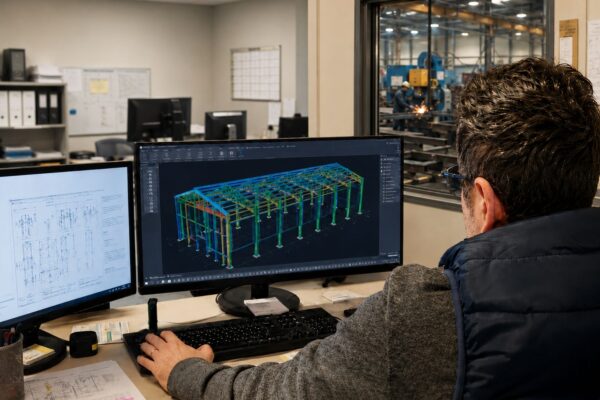
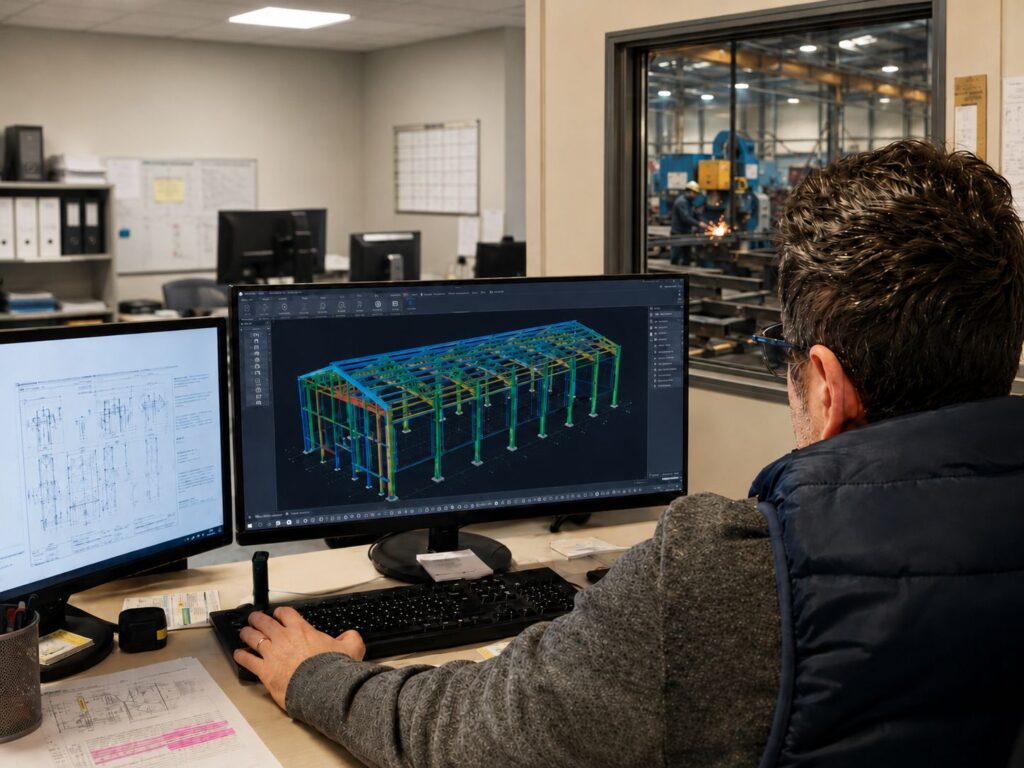
The problem isn’t anyone’s bad faith. It’s the lack of a detailed engineering process prior to the start of construction. If the structure hasn’t been modeled in 3D with the systems incorporated into it before anything is manufactured, a clash is practically inevitable.
Construction systems that require all the geometry to be determined before fabrication—because there’s no room for improvisation in the workshop—are the ones that arrive on-site without any surprises. The beams can be produced with the necessary pipe passages and cavities already in place, all perfectly calculated. Utility lines run cleanly through the structure, without any notches or modifications.
This is a good example of how the “rigidity” of the workshop process is, in fact, a huge advantage: it forces you to think everything through before building. And that is exactly what sets apart a project that is completed on time from one that sparks arguments right up until the very last day.
In rigid systems, any future modification involves costly construction work, structural uncertainty, and, in many cases, the decision not to proceed. The building is effectively frozen in time.
What These Five Mistakes Have in Common
None of them appear in the initial budget. They all show up later, once the project is already underway and making changes is very difficult or impossible.
The good news is that all of these issues are preventable. The key isn’t in choosing the cheapest or best-known supplier. It lies in choosing a construction system based on the EFFECTIVE TIME FACTOR—one that solves the problem before it reaches the job site: one that doesn’t bring construction to a standstill, doesn’t compromise the foundation, doesn’t depend on external chance, doesn’t jeopardize the building’s future, and doesn’t cause conflicts between trades.
At Jansa Metal, we’ve been solving exactly that for over 40 years. If you have a project in the works, tell us what it’s about.