

By Joan Juanola, CEO of Jansa Metal, over 40 years fabricating and erecting steel structures
The difference between a programme and a commitment
When we talk about construction schedules, the first thing to define is what kind of planning we mean. A programme drawn up on a sheet, paper or digital, can be adjusted at will, depending on the milestones we need to hit. Whatever the format, it will always reflect a more or less optimistic “wish” or “forecast”.
It is well known that schedules on construction sites are rarely met. There are always reasons, even excuses, that change them. To give just one example, we all have the Camp Nou delays in mind. A world-class project with apparently unlimited resources, and the schedule went out of the window.
When we talk about real deadlines that must be met with no excuses, the picture changes completely. The reliability of a programme depends on many factors. In our experience (more than 4,000 projects completed since 1982) they come down to four critical factors.
But before going into them, let’s get to what most of you want to know when you arrive at this article: how long does a steel structure project really take from start to finish?
Real timings, phase by phase
There is no magic here. There is work, coordination and a factory that runs in parallel with the site. This is what we see on standard projects from 50 tonnes upwards:
Phase 1 – Engineering and technical design, 2 to 6 weeks
The structural design, fabrication drawings, 3D BIM model and detailed design with every connection and purlin detail… All of this has to be finalised and approved before the workshop cuts the first section. On complex projects such as data centres, hospitals or bespoke structures, this phase can take from 1 to 3 months depending on the volume and complexity of the project. For standard industrial buildings, we are ready in 2–3 weeks.
The most common mistake we see in the industry: starting fabrication with the engineering half done. The result: changes that force improvised alterations in the workshop, erection delays, extra costs, lost quality and often lost traceability.
Phase 2 – Workshop fabrication, 4 to 10 weeks
This is where a well-equipped factory makes the difference. At Jansa we work with the latest automated CNC production lines: welding robots, plasma and laser cutting lines. We do not improvise: we fabricate precisely and guarantee quality and traceability
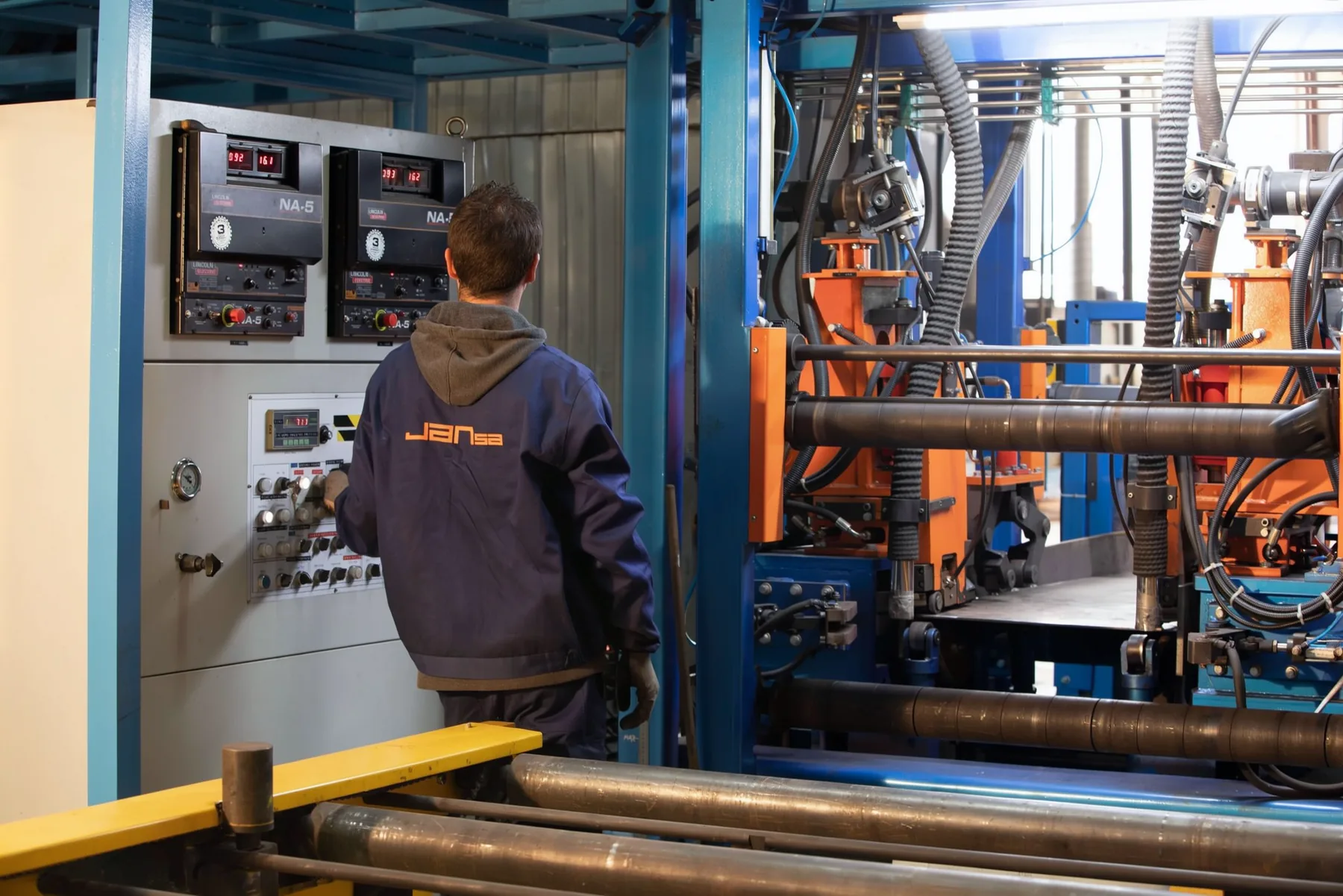

For an industrial building of 2,000 to 10,000 m², we are talking about 2 to 5 weeks of fabrication. For structures of 500 to 1,000 tonnes such as shopping centres, corporate buildings or data centres, the estimated time is between 5 and 10 weeks.
The key nobody mentions: while excavation is starting, we are already fabricating. That is real CONVERGENCE. Steel does not wait for concrete to harden. IF A REAL BUILD TEAM IS FORMED and coordination between the developer, the civil contractor and us is good, we gain MANY weeks on site, with no rushing or improvising — safe work, step by step, always forward, never back. Sometimes the snail gets there before the hare: the snail never goes backwards.

Phase 3 – Transport and logistics: variable, but plannable
Transport is not a secondary phase. It is vital because it feeds erection. Parts leave the FACTORY marked, numbered and sorted in the order of erection on site, not the order of fabrication. That stops the erection crew from hunting for parts or unloading trucks in the wrong order.

Phase 4 – Erection on site, 1 to 8 weeks depending on scale
And here we reach the point that sets steel apart from in-situ concrete: erection speed is ASTONISHING when everything before it has been done well.
A 2,000 m² industrial building with a simple structure can be erected in 1–2 weeks.
A 300–500 tonne multi-storey building structure, in 4 to 8 weeks.
A data centre with a complex structure, irregular geometry and high technical requirements, like the data centre we built in Badalona, takes around 6–8 weeks to erect.

Steel needs no curing time. There is no waiting. What is fabricated today is ready and painted for loading tomorrow.
Summary of indicative lead times for the most common projects
| Project type | Engineering | Fabrication | Erection | Approximate total |
|---|---|---|---|---|
| Simple industrial building (60-100 t) | 2-3 wks | 3-5 wks | 2-3 wks | 7 to 11 weeks |
| Complex industrial building (200-800 t) | 3-5 wks | 5-10 wks | 3-6 wks | 11 to 21 weeks |
| Multi-storey building (400-1,000 t) | 4-7 wks | 7-10 wks | 5-10 wks | 16 to 27 weeks |
| Bespoke structure (400-1,000 t) | 7-10 wks | 10-14 wks | 6-12 wks | 23 to 36 weeks |
These lead times are indicative and assume finalised engineering and anchors set AND CHECKED, with a BUILD TEAM coordinating smoothly between all parties. Fabrication and erection partly overlap with the civil works.
4 critical factors that decide whether a deadline is met
1) A reliable building system, from the foundations to the last bolt
A building system is reliable when it is backed by proven experience, tested again and again and improved on every project. Reliability is the result of a CONSTRUCTION PROCESS, years of experience and continuous improvement: there are NO SHORTCUTS.
*A warning about something often overlooked: a building system is only as reliable as its weakest link. It is no use erecting the structure perfectly if the previous step, the foundations and anchor setting, runs late. A delay at that stage drags everything after it. And what comes after involves resources that do not wait: a special crane booked for a specific date, an erection crew with a full diary, a client with an immovable start date. Technical resources and skilled staff are scarcer every day. A delay is not easily recovered and can be irreversible
That is why at Jansa we believe we must manage and secure a CONSTRUCTION PROCESS that starts with the foundations and ends with the last bolt tightened. And that process has to work like clockwork.
Weekly programme tracking.
To make sure the system runs as planned, you have to measure and check every week that execution is following the agreed sequence, and act immediately on any deviation. Do not wait for the next site meeting. Act straight away. Reaction time on site is what separates a manageable problem from a chain of delays.
The Plug & Play connection system, no improvisation on site
This software term perfectly describes what a structural connection on site should be: Plug & Play. You connect it and it works. No last-minute checks, no uncertainty.
Today only bolted connections guarantee that. Site welding has two fundamental problems that make it incompatible with rigorous schedule management.
First, it requires a highly skilled welder, but it also depends on “their circumstances”: their condition, the environment, the weather. The best welder in the world can have a bad day. The consequences can even halt progress on site.
Second, quality control of a weld stops progress. If a defect is found, work does not just stop: it goes backwards.
A bolted connection only requires pulling the trigger of a bolting gun until it stops at the required tightening torque. Bolting time is predictable to within a minute either way. Quality control can be done at any time without affecting progress. No surprises. No weather delays. No dependence on physical condition or circumstances.
Fabrication to ±1 mm
For a bolted connection system to work like a construction kit, the structure must be fabricated to an accuracy of ±1 mm. It is the technical requirement that lets every part fit the next with no adjustment on site, no grinding, no improvisation. In our factory, thanks to automated cutting and drilling, we ensure the quality and precision of production every day.
The anchor system: the most critical point of the whole project
If we had to name the single biggest cause of delays on steel structure projects, it would be this: badly installed foundation anchors. It is the main source of problems on site, and the most underestimated at the planning stage.
For a bolted structure with millimetre accuracy to be erected like the kit it is, the anchors must be set with the same accuracy. This task, often taken for granted, cannot be left to chance. The process has to be clearly defined, carried out rigorously and verified.
At Jansa we manage it like this: before the concrete pour, the anchors are surveyed and a preliminary setting-out certificate is signed. Only then is the concrete poured. Once poured, the position is checked again and a final setting-out certificate is signed. That document is what starts erection of the structure. Without it, nothing is erected. No exceptions.
2) Adverse weather: the real excuse and the easy excuse
Let’s be clear: weather does affect erection. A day of strong wind can stop the crane. A week of heavy rain can restrict access to site. That is real and nobody can change it.
What is not acceptable is using the weather as an excuse for delays that actually come from poor planning. In our experience, most of the “rain delays” we see in the industry are really delays caused by missing materials, last-minute design changes or poor coordination between trades.
The difference is that it doesn’t rain in the FACTORY. Fabrication does not stop because the weather is bad on site. A good programme allows realistic weather contingencies of 2 or 3 days per month in winter in Atlantic climates, and practically none in summer in Mediterranean areas
3) Teamwork pulling in one direction
This is the factor that appears least in contracts and does the most DAMAGE when it is missing. A well-executed steel structure project requires engineering, the FACTORY and the site to pull in the same direction from day one.
In practice, that means 4 PRINCIPLES.
1) A STRUCTURED, APPROVED DETAILED DESIGN
A WELL-STRUCTURED DETAILED DESIGN: the Germans say “it is half the execution”. Really, with a well-structured detailed design and a reliable construction process, the project will move like a freight train.
2) NO DESIGN CHANGES
A design change when you already have 200 tonnes fabricated is not an “adjustment”: it is a problem THAT CANNOT BE FIXED WITHOUT AFFECTING THE PROGRAMME. Any necessary changes will be made at the end of each erection phase without disrupting the planned programme.
3) BUILD TEAM
Teamwork based on approved drawings, each member of the team focused on doing their job right and on time, with real-time information about problems and unforeseen events so they can be dealt with immediately.
4) SUPPLY CHAIN
Transport is planned around the erection sequence, not around anyone’s convenience
Parts arrive on site in the order they will be erected. And the erection crew knows the project before setting foot on site: with the 3D IFC model we produce in engineering, every erector knows exactly which part goes where, in what position and with what connection, before getting out of the van.
At Jansa we have worked this way for 40 years because we learned (sometimes the hard way, like everyone) that speed on site is the result of coordination beforehand — not of running faster, but of working within a structured process with no changes and no steps backwards
4) Complexity of the structural project
The fourth factor varies most from one project to another and is the most often underestimated at tender stage. Designing, fabricating and erecting an orthogonal industrial building with conventional loads is not the same as tackling a data centre with seismic requirements, composite floors, unusual geometries and high fire resistance requirements. Not in time, not in technical resources and not in acceptable margin of error.
Structural complexity has a direct and proportional impact on every phase of the project. In engineering, a complex structure does not just need more calculation hours: it needs more validation iterations, more coordination with other specialists (services, façade, concrete structure…) and more detail in the fabrication drawings.
In the workshop, complexity means one-off parts that cannot be produced in series, special connections that need more dimensional control and welding times that do not follow the standard production rhythm.
On site, irregular geometry or special loads may require specific lifting equipment, more demanding erection sequences and greater technical supervision on the ground.
This is not a problem, it is the reality of the industry. The problem arises when the same schedules are applied to projects of radically different complexity. At Jansa, before committing to any date, we analyse the project’s real complexity (not the one in the executive summary, but the one on the drawings), because a schedule that is wrong from the start is a delay waiting to happen.
We have delivered projects of every kind: 10,000 m² logistics buildings on very tight schedules, steel residential buildings, infrastructure footbridges, hospitals, shopping centres, waste treatment plants and data centres with extreme technical requirements. Each has its own logic. Knowing that logic in advance is what allows us to give schedules that we then meet.
Final summary and conclusions on real lead times in steel structure projects
A construction schedule for a steel structure is not a promise: it is the result of getting every earlier phase right. If the engineering is finalised, if the workshop runs in parallel with the foundations, if the anchors are surveyed before the pour, if transport arrives in erection order, if connections are bolted and do not depend on anyone’s mood, and if the site team knows exactly what to do before arriving: deadlines are met. Not by chance. By method.
At Jansa we have been proving it for more than 40 years. More than 4,000 projects completed, from logistics buildings to data centres, from hospitals to solar carports, with one thing in common: we hit the agreed date.
If you have a project in hand and want to know what lead time is realistic for your case, contact our team. No obligation and no frills.
Jansa Metal, steel structure manufacturers since 1982. Engineering, fabrication and erection. EN 1090 EXC3 certified.