Some suppliers show off a certificate like a trophy. Others understand what lies behind it. The difference could cost you a project, a fine or worse.
Imagine you hire a steel structure supplier. They send you their EN 1090 certificate. You sign the contract. And three months later, during an inspection, you discover that the certificate does not cover the execution class your project needs.
It is not a made-up scenario. It happens. And when it does, the problem is yours.
That is why this article is not going to be a copy of the official gazette. It is what you need to know before choosing someone to fabricate your structures.
What EN 1090 is and why it matters more than you think
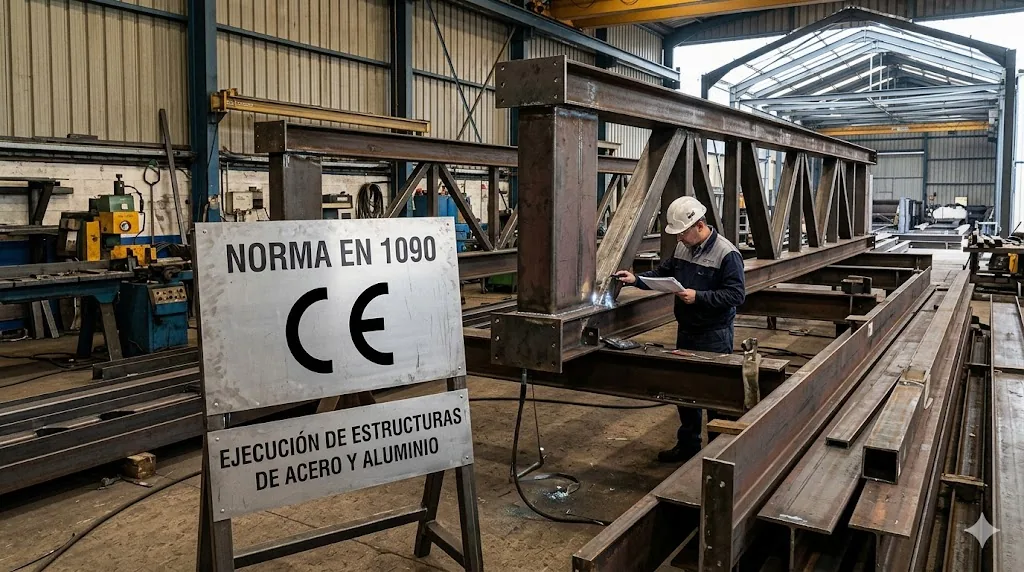
The European standard EN 1090 governs the fabrication of steel and aluminium structural components. It has been mandatory since 2014, in Spain and across the rest of the European Union. Without it, a steel structure cannot carry CE marking. Without CE marking, it cannot legally be placed on the market.
So far, the basics.
What many people do not know is that EN 1090 is not a single thing. It is divided into parts and, within those parts, into different levels of requirement depending on the type of structure or project.
| THE PARTS OF EN 1090 EN 1090-1 — Requirements for conformity assessment of structural components. CE marking.EN 1090-2 — Technical requirements for steel structures. The one that most affects fabrication.EN 1090-3 — Technical requirements for aluminium structures. |
The core is in part 2. And within it, in something called the execution class.
Execution classes: the detail that changes everything
The standard defines four execution classes (EXC1, EXC2, EXC3, EXC4). Each involves a different level of control, documentation and technical requirements. A supplier can be certified for EXC2 and not qualified for EXC3. If your project requires EXC3 and the supplier only has EXC2, their certificate is no use to you. Full stop.
| Class | Typical use | Requirement |
|---|---|---|
| EXC1 | Agricultural buildings, residential railings, structures with few people present | Minimal |
| EXC2 | Buildings of 2 to 15 storeys, conventional industrial buildings. The most common on the market | Standard |
| EXC3 | Structures with dynamic loads, fatigue, high seismicity, buildings over 15 storeys, footbridges, long-span roofs. The real ceiling of the industry. Jansa Metal’s certification | High |
| EXC4 | Exceptional cases: tanks in nuclear power plants, large railway bridges. Additional requirements defined project by project | Maximum · exceptional cases |
An important clarification before going on: EXC4 exists, but in industry practice it is marginal. It applies to critical infrastructure of an almost exceptional nature — safety tanks in nuclear power plants, large railway bridges — where additional requirements are defined project by project. For demanding industrial structures, EXC3 is the level that covers everything you need. It is the real ceiling of the mainstream market.
“An EN 1090 certificate that does not cover your execution class is worthless paper with an official stamp.”
How is your project’s execution class determined?
It depends on three intersecting factors: the consequence of failure (what happens if the structure fails), the service category (seismic loads, fatigue, etc.) and the production category (whether there are welds on critical elements).
In conventional buildings, EXC2 is the norm. But for long-span industrial roofs, footbridges, structures subject to fatigue or in seismic zones, EXC3 is required. The execution class must be defined in the project or technical documentation. If it is not, it is essential to clarify it before fabrication.
What EN 1090-2 really requires
Beyond the execution class, the standard sets requirements for the whole production process. It is not just about having certified welders. It is about having a complete system that works.
Material traceability
The traceability system must make it possible to identify the origin of the material in line with the project and standard requirements.
Qualified and certified personnel
Welders must be qualified to EN ISO 9606. Welding coordinators, to EN ISO 14731. It is not enough that they know how to weld. There must be documentation to prove it and a system that ensures those qualifications are current.
Quality control plan and ITP
The fabricator must have an Inspection and Test Plan (ITP) or equivalent system within its factory production control (FPC). What is inspected, by what method, how often and by whom.
Weld inspection
Depending on the execution class and project specifications, welds must be inspected by non-destructive testing (NDT).
When the project or execution class requires it, reports of these tests must be included in the final documentation. In EXC3, acceptance criteria are usually set at demanding levels (typically level B or C under EN ISO 5817), although they must always match what is defined in the project.
| Warning sign: if a supplier cannot give you the weld test report together with the structure’s documentation, something is wrong. |
Declaration of Performance (DoP)
CE marking is not just a logo. It comes with a Declaration of Performance that specifies the component’s characteristics. Without this document, the CE marking has no legal value.
How to check that a supplier really complies
This is the part nobody explains. Because asking for the certificate is easy. The hard part is knowing whether that certificate matches what they are going to fabricate for you.
1. Ask for the certificate and read it
The certificate of conformity of the factory production control (FPC) must be issued by a notified body. Check that the body is registered in NANDO (the European Commission’s official database). And check that the certified execution class matches the one you need.
| You can check notified bodies at: ec.europa.eu/growth/tools-databases/nando |
2. Ask for the exact scope of the certification
Certification may be limited to certain types of connections, thicknesses or materials. An honest supplier tells you. One who does not may not know, or may prefer that you do not know. If the supplier has EXC3 with no scope restrictions, that is a sign their quality system is mature.
3. Ask about the welding coordinator
Who is it? EN 1090 requires a coordinator with specific technical knowledge (to EN ISO 14731). For EXC3, that competence must be validated and verified by the notified body. At Jansa Metal, our technical organisation does not just comply on paper: it ensures that supervision of welding processes is real, constant and professional. If the coordinator does not have proven technical capability for the level of your project, the certificate is just a piece of paper.
4. Visit the facilities
Nothing replaces seeing how they work. An EXC3-certified workshop has a recognisable order: identified materials, separate zones, visible procedures, accessible records. If you walk into a workshop and see none of that, the certificate does not reflect reality.
5. Ask for examples of documentation delivered
Any serious fabricator can show you, with due confidentiality, examples of the documentation they hand over to clients: technical dossier, inspection reports, material certificates, Declaration of Performance. If they have nothing to show you, they have a problem.
QUICK CHECKLIST
EN 1090 certificate issued by a notified body, verifiable in NANDO
Certified execution class that covers the one your project requires
Welding coordinator with proven, validated technical competence for EXC3.
Welders with current qualifications to EN ISO 9606
Documented inspection and test plan (ITP)
Material certificates (heat numbers) available for every delivery
Non-destructive test reports included in the handover documentation
Declaration of Performance (DoP) supplied with the CE marking
The most common mistake buyers make
Treating EN 1090 as an administrative box to tick, instead of what it is: the guarantee that what is fabricated for you will withstand what it has to withstand.
A steel structure does not fail on the day it is handed over. It fails years later, under conditions it was not prepared for, because nobody checked whether the supplier was really capable of fabricating it.
“The cheapest structure is not the one with the lowest price. It is the one that does not fail.”
At Jansa Metal we fabricate steel structures with EN 1090 certification up to EXC3. We do not say it to show off a piece of paper. We say it because when a client brings us a project with dynamic loads, in a seismic zone or with a long-span roof, we want to be able to say yes, we can fabricate it, and with the level of control that project deserves.
| What EXC3 means in practice: full material traceability, welding coordination by a full-time IWE, non-destructive testing with level B acceptance criteria, and all documentation ready for any inspection. If your project does not need EXC3, even better: we fabricate it just as well to EXC2, and explain it so you know exactly what you are buying. |
If you have a project in hand and want to understand exactly which execution class you need, and whether what a supplier is offering really covers it, we can help you analyse it. No obligation and no unnecessary jargon.
Have a project that requires EN 1090?
Tell us what you need. We will tell you straight which execution class applies and whether we can fabricate it with guarantees.